Planning a Kitchen Renovation Without Starting From Scratch

Welcome to your guide for kitchen renovation planning from Sweet Lydia’s Kitchen. If you’re tired of looking at outdated cabinets or struggling with a kitchen layout that just doesn’t work, you’re in the right place. The good news? You don’t need to tear everything down to bare walls.
This approach focuses on keeping what works while fixing the parts that frustrate you daily. You’ll save money, reduce construction time, and still get a space that feels brand new.
We’ll walk through practical kitchen design tips that help you make smarter decisions. From evaluating your current kitchen to planning updates that actually matter, this step-by-step guide covers everything you need for a successful kitchen remodel.
Kitchen Renovation Planning vs. a Full Kitchen Remodel: What’s Different?
Kitchen renovation planning means updating specific problem areas while keeping your existing layout intact. A full kitchen remodel tears everything out, right down to the studs.
Have a look at the following quick table for a better idea:
|
Renovation Planning |
Full Remodel |
|
Keep the existing layout |
Start from bare walls |
|
$15,000-$35,000 |
$40,000-$80,000 |
|
3-6 weeks |
3-4 months |
|
Update problem areas |
Replace everything |
Here’s what makes renovation planning smarter. You preserve the bones of your space (and the damage adds up fast) when you start ripping out functional elements. Your sink stays put, so plumbing costs stay reasonable.
Remember, the kitchen layout already works for traffic flow. You’re just making it work better for how you actually cook and use the room.
Start With Your Current Kitchen: What’s Already Working?
Most homeowners waste money replacing things that already work perfectly fine. Here’s the thing… before you plan any kitchen renovation, walk through your space with fresh eyes. Look for what’s actually broken versus what just looks dated.
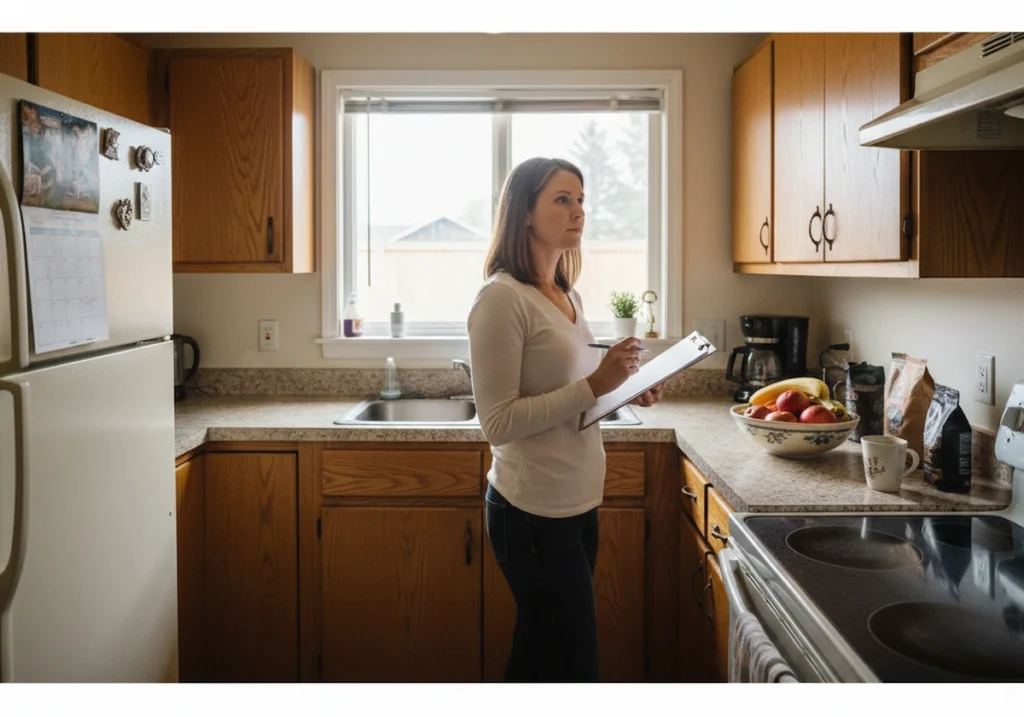
- Appliance placement and workflow: Does your fridge open without blocking the doorway? Can you reach from the sink to the stove in two steps? Measure the distances. The work triangle between your sink, stove, and refrigerator should total between 13 and 26 feet. If you’re already in that range, keep the layout. Moving a gas stove means hiring a licensed plumber to relocate the line. Shifting your dishwasher just six inches can cost $800 in new plumbing and electrical hookups.
- Cabinet boxes and structure: Open every base cabinet and upper cabinet. Run your hand along the interior corners, checking for soft spots or water stains. Tap the sides. Solid wood boxes sound dense, not hollow. If the frames are sturdy, you hit the nail on the head with cabinet refacing. New doors, drawer fronts, and hardware transform the look for $4,000 to $8,000 instead of $15,000 for complete replacement. Check if your drawers have soft-close glides already installed. Those are worth keeping.
- Lighting coverage: Stand where you chop vegetables and read recipes. Can you see clearly without shadows? Count your current fixtures. Kitchens need about 50 lumens per square foot. A 150-square-foot kitchen needs roughly 7,500 lumens total. Sometimes, swapping old fluorescent fixtures for LED panels solves the problem. Under-cabinet lighting adds task lighting without rewiring your ceiling.
- Storage space: Measure the vertical space inside your tall cabinets. Most have 12 to 18 inches of wasted height at the top. Pull-out shelves in lower cabinets let you access items in the back. Drawer organizers for your sheet pans and cutting boards cost $50 but work like custom cabinetry.
Start here, and you’ll know exactly where your money should go. Skip this assessment, and you might gut a kitchen layout that already functions well.
Kitchen Design Tips: Which Elements Actually Need Changing?
Knowing what to replace versus what to refresh can cut your kitchen renovation budget in half. Now here’s where it gets tricky… some updates deliver massive visual impact for relatively low cost, while others eat your budget without much payoff.
Let’s break down the big decisions.
Cabinets vs. Cabinet Refacing
Cabinet replacement runs $8,000 to $20,000 for an average kitchen. Refacing? You’re looking at $4,000 to $9,000 and wrapping up in three days instead of three weeks. The difference comes down to what you keep.
With refacing, your existing boxes stay put. You swap out doors, drawer fronts, and hardware (sounds tedious, we know). The layout doesn’t change, so if you need more storage or want to squeeze in an island, this won’t solve that problem.
However, when the cabinet locations already make sense, and the boxes are structurally solid, refacing gives you that dream kitchen look. No demolition dust. No waiting weeks for custom cabinetry. Plus, you can paint those refreshed cabinets for $200 to $600 if you tackle it yourself.
Two-tone cabinetry creates visual interest. Darker base cabinets paired with lighter upper cabinets make your ceiling look higher. New hardware seals the deal. Brass pulls, or matte black handles, run $3 to $15 per piece and completely shift the vibe.
Countertop Space: Swaps That Make Sense
Countertops transform your kitchen design without touching what’s underneath. Quartz countertops sit in the $50 to $120 per square foot range, installed. What makes them worth it? Well, they resist stains better than marble and skip the annual sealing that granite demands.
A matte kitchen finish hides fingerprints and water spots that show up on polished stone. Laminate has come a long way, too. Modern patterns mimic natural stone for $20 to $50 per square foot, and most people can’t tell the difference from across the room.
Now let’s talk backsplash. Subway tile runs $8 to $15 per square foot with installation. Peel-and-stick options work great for renters or anyone watching their budget closely at $1 to $3 per square foot.
Your backsplash does double duty. It protects walls from cooking splatter while adding color and texture to the space. The trick is simple: pick materials that complement your countertop without matching exactly. Different colors in similar tones create depth instead of that flat, showroom look.
Kitchen Layout Improvements Without Moving Plumbing
Keeping your plumbing where it is saves you $3,000 to $8,000 in rerouting costs alone. In our experience with hundreds of kitchen projects, the sink location becomes the anchor point for everything else. Moving it means breaking through floors, rerouting drain lines, and dealing with venting issues that weren’t in your original plan.
Your dishwasher sits next to the sink because it shares the same water supply and drain. Relocating either one triggers a domino effect. However, you can still improve your kitchen layout dramatically without touching a single pipe.
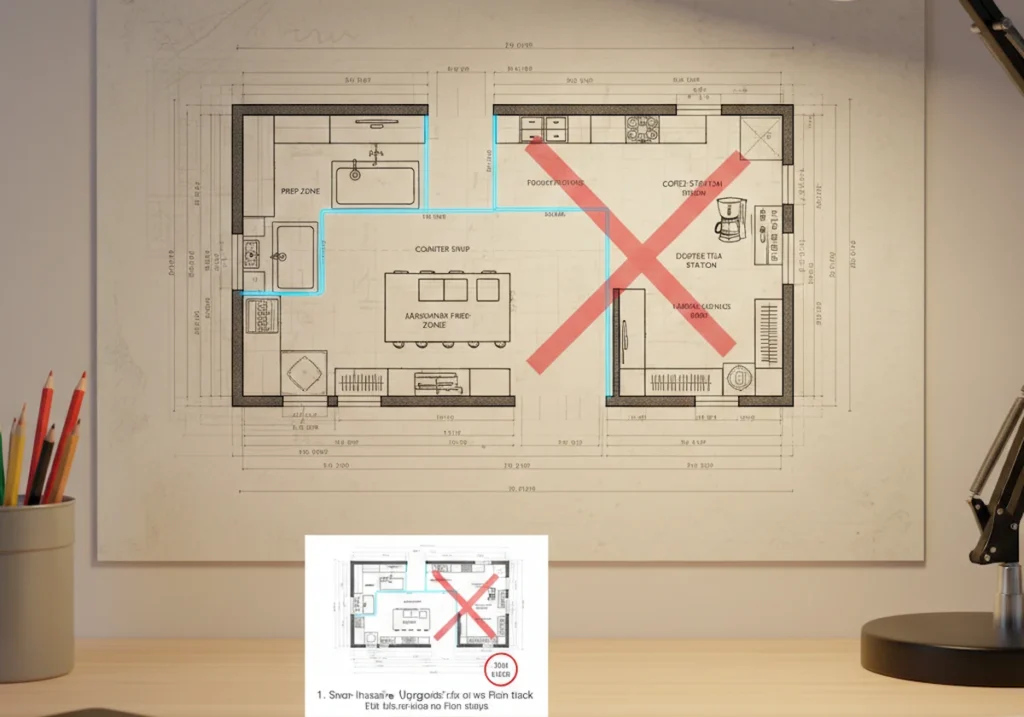
Appliances offer more flexibility than you’d think. Your fridge only needs an electrical outlet, so moving it to an adjacent wall usually works within your current setup. Electric ovens and stoves follow the same logic. Islands change workflow without requiring plumbing unless you add a farmhouse sink. A basic island with countertop space and storage runs $2,000 to $5,000.
Kitchen Reno: Small Shifts That Create Big Changes
You’d be surprised how much better your kitchen flows after moving just one or two elements. Want to know the best part? These changes don’t require permits or major construction.
- Remove upper cabinets on one wall: Opening up one section instantly makes the space feel larger. Natural light floods in from windows that were partially blocked before. Swapping those cabinets for open shelving gives you a spot to display dishes while the cramped feeling disappears.
- Extend countertops by 12-18 inches: Adding counter space where you need it most changes everything about meal prep. An overhang on your island doubles as bar seating for quick breakfasts. This approach works beautifully when creating an eco-friendly kitchen workspace with room for composting bins right where you cook.
- Relocate your fridge to an adjacent wall: Moving the refrigerator just a few feet opens up traffic flow in ways you wouldn’t expect. Since it only needs an electrical outlet, the whole project costs $150 to $300. The space suddenly feels like a completely different kitchen layout without replumbing.
- Add an appliance garage: That cluttered corner with your toaster and coffee maker gets tucked behind a roll-up cabinet door. Counter space opens up while everything stays within arm’s reach for around $200 to $600.
Small shifts like these prove that great kitchens don’t always need complete overhauls.
Budget-Friendly Kitchen Remodel Moves
Now that you know what to keep, here’s where your money makes the biggest difference. After years of working with kitchen renovations, we’ve seen which projects deliver the most bang for your buck straight away.
|
Project |
DIY Cost |
Pro Cost |
Impact Level |
|
Cabinet hardware swap |
$150-$400 |
$300-$600 |
High |
|
Paint cabinets |
$200-$600 |
$1,000-$3,000 |
High |
|
Peel-and-stick backsplash |
$100-$300 |
N/A |
Medium |
|
New lighting fixtures |
$200-$800 |
$500-$1,500 |
High |
|
Laminate countertops |
N/A |
$1,200-$3,000 |
High |
|
Drawer organizers |
$150-$400 |
$300-$700 |
Medium |
The table shows you don’t need $20,000 saved up before starting. Swapping cabinet hardware this month for $300 makes an instant difference. Paint those same cabinets next month for another $500. By spreading updates across three to six months, you avoid debt while seeing progress each time you walk into the room.
Kitchen Renovation Timeline: What Takes Longer Than You Think?
Three months sounds reasonable until you factor in what actually slows down kitchen projects. Fair warning, though… the materials you want might not arrive when promised.
Custom cabinet doors take 6 to 12 weeks from order to delivery. While you’re waiting on those, quartz countertops need another 3 to 6 weeks after templating. On top of that, special tile for your backsplash can sit on backorder for 8 weeks (not the most exciting task, admittedly).
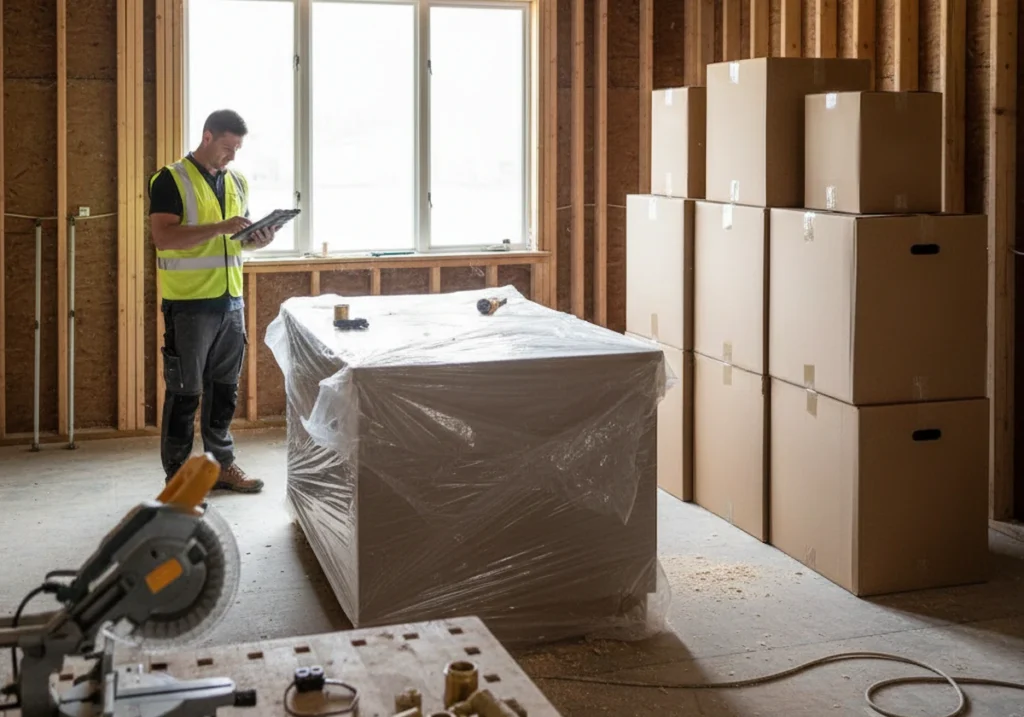
Lead times represent just one piece of the puzzle. Keep an eye on permit approvals, too, since electrical work needs inspection even for adding a few outlets. Beyond that, structural changes like removing walls require engineer approval before anyone touches a hammer.
The approval process adds 2 to 4 weeks in most cities. What’s more, gas line modifications always need professional certification and multiple inspections that stretch the timeline even further.
Then there’s the coordination challenge between trades. Your electrician can’t install pendant lights until the ceiling paint dries completely. After that, countertop installers won’t template until the cabinets are perfectly level. When one trade runs behind schedule, everyone else shifts back a week.
Your Next Steps for a New Kitchen Update
Start by walking through your current kitchen with a notebook. Write down what frustrates you daily and what actually works well. That assessment tells you exactly where your money should go instead of guessing at problems that might not exist.
Prioritize changes based on how you cook and use the space. If you’re constantly running out of counter space, that matters more than updating cabinet hardware. Focus on solving real problems before chasing aesthetic upgrades that look good but don’t improve function.
Ready to plan your kitchen renovation with someone who understands your cooking habits and lifestyle? Get in contact with Sweet Lydia’s Kitchen for personalized renovation planning. We’ll help you create a space that works beautifully for how you actually live.