How Kitchen Layout Affects Cooking Efficiency and Comfort
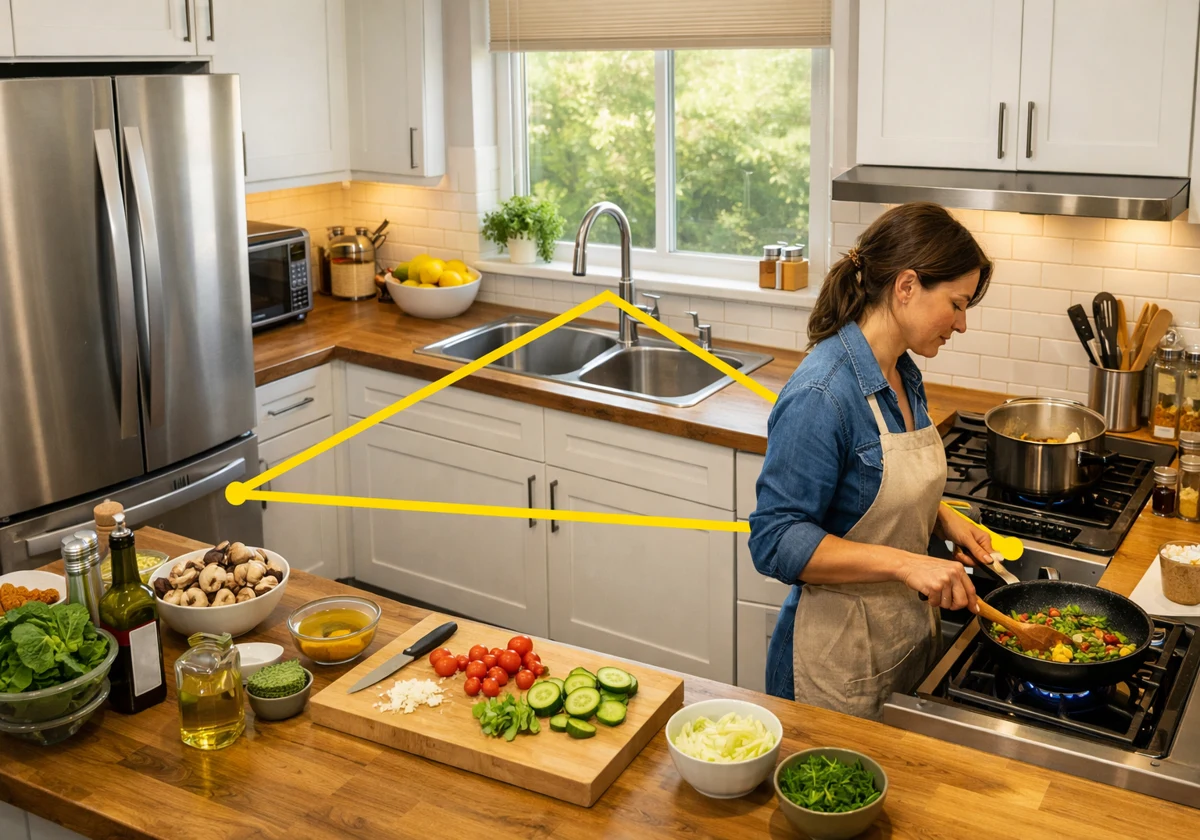
Kitchen layout design affects your cooking efficiency and comfort by deciding how far you walk between the sink, stove, and fridge during meal preparation.
When the layout works against you, simple dinners become frustrating marathons around the room. Meanwhile, good space planning keeps pots, pans, and ingredients where you need them without extra steps.
In this article, you’ll learn how kitchen workflow changes based on layout type, where your cooking zone should sit for comfort, and how to determine cabinet dimensions based on your actual reach.
Let’s get started.
Why Kitchen Layout Design Controls Your Daily Cooking
Kitchen layout design controls your daily cooking because it dictates the distance between your workstations and how efficiently you move through meal preparation.
Besides, your layout directly affects how many steps you take between the stove, sink, and fridge during cooking. Frankly, most people don’t realize how much energy they waste until they track their steps during one dinner prep.
From what we’ve seen, poor spacing between workstations adds 15-20 minutes more cooking time. For instance, when you need a pot from one corner and spices from another while something’s heating on the stove, you’re zigzagging across the kitchen instead of cooking. This extra walking drains your energy before you even start eating.
But a well-planned configuration reduces physical strain and lets multiple people cook without bumping into each other constantly. If you’ve got kids helping with meal preparation or someone unloading the dishwasher while you’re at the stove, adequate space between work areas prevents awkward crossing.
The most efficient kitchen layout keeps cooking space and storage space within a comfortable work triangle.
Efficient Kitchen Layout: The Foundation of Your Cooking Space
Ever notice how some kitchens feel like they cook for you while others fight you every step? (and yes, we’ve all been there, circling the kitchen like you’re lost)
The difference here lies in how your cooking space handles kitchen workflow. Generally, an efficient kitchen layout puts everything where you need it without forcing you to cross the room constantly.
Now, let’s look at what builds that foundation in your cooking space:
Creating Zones That Match Your Cooking Style
Bakers need dedicated counter space near ovens. Stir-fry cooks, on the other hand, want everything within arm’s reach of the stove.
This way, when you create zones for prep, cooking, and cleanup, food preparation stays organized, and raw ingredients stay away from cooked food. Separate areas for food storage, and keep pantry items easily accessible.
So, your cooking frequency determines if you need a compact setup or an expanded workspace with multiple stations.
Cabinet Dimensions Based on How You Actually Cook
Standard 24-inch deep cabinets waste space if you mostly use small appliances and everyday dishes. Here, the upper cabinet dimensions should match your reach so you can use the top shelves regularly.
Plus, pull-out shelves and drawer dividers help organize pots, baking sheets, and small utensils.
Drawing from our experience working with homeowners, we’ve found that most people only use their top shelves about twice a month, if they can reach them comfortably.
Appliance Integration Without the Guesswork
When you incorporate appliances into your layout, refrigerator placement affects how quickly you access ingredients during cooking. That’s why you need to keep the fridge close to your prep area for quick access, ideally within three steps.
Dishwasher location near the sink also saves time unloading clean dishes and loading dirty ones after meals (because nobody wants to walk 15 steps with a hot casserole dish).
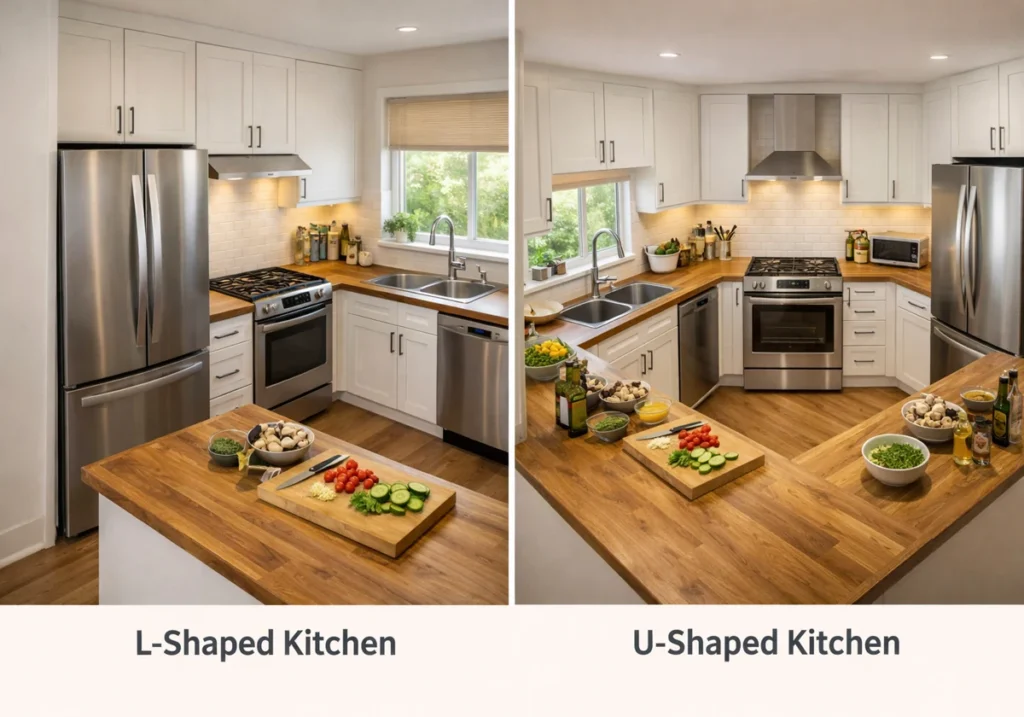
Beyond these, how appliances are laid out in an L-shaped kitchen or a U-shaped kitchen changes your cooking workflow completely.
Once that’s established, the focus shifts to how your body moves through all those zones.
Ergonomic Kitchen Design: When Comfort Meets How You Move
The best part about ergonomic kitchen design is that you finish cooking without a sore back or aching feet. Because this kitchen considers how your body moves during meal preparation, not just where appliances fit.
Learn the following two factors that will determine your comfort and movement together:
The Cooking Zone Setup That Saves Your Back
Stove placement at a comfortable height keeps pots at eye level without straining shoulders during stirring. There’s no way around this. Because if you’re bending down 20 times a day to grab pots, your back will remind you by evening.
On top of that, pull-out shelves in lower cabinets eliminate deep bending to retrieve heavy mixing bowls daily. Plus, overhead lighting positioned directly above work surfaces prevents hunching over to see what you’re chopping.
What’s more, open countertop space gives you room to work without twisting around appliances, and additional counter space near the stove keeps ingredients within arm’s reach while you’re cooking.
Kitchen Island Placement for Real Workflow
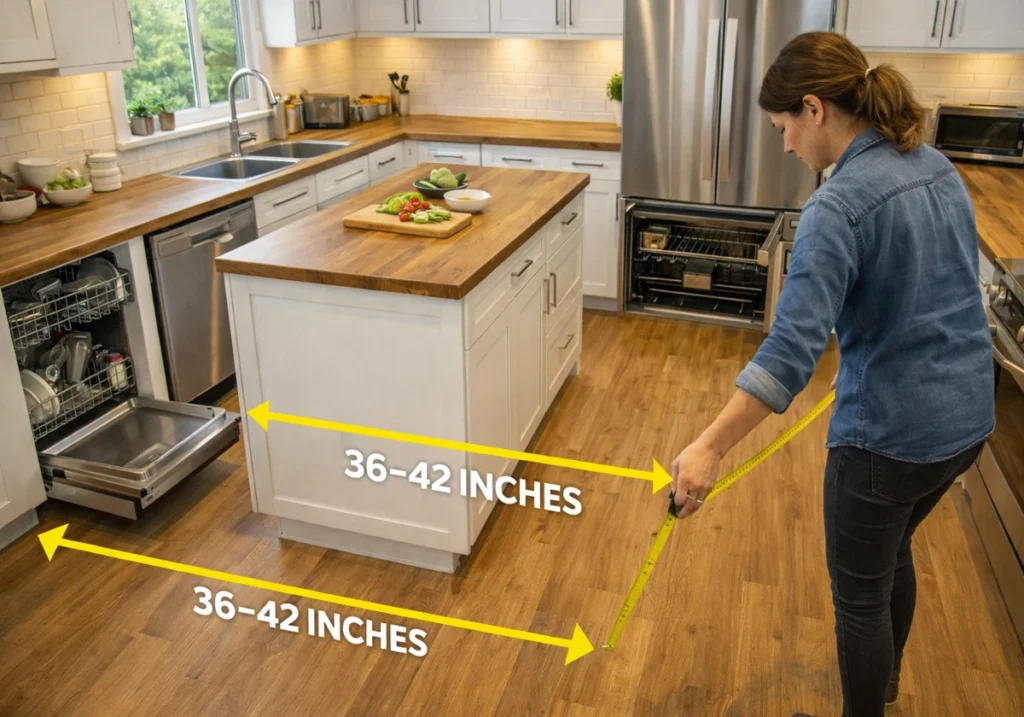
Generally, islands work best 36-42 inches from perimeter counters, which gives you enough room to open cabinets and appliances fully. Here, the measurement is mainly width, though the ideal width depends on how many people cook together.
The 36–42 inch clearance rule consistently proves itself once families start cooking. As the space evolves, adding seating later changes traffic flow, overhang depth, and stool height. Together, all of these affect how people move around the area.
From there, you need to think beyond today’s cooking habits.
Quick tip: Match the island size according to your kitchen square footage. Oversized islands in small kitchens create navigation problems constantly.
What Makes a Kitchen Work Long-Term?
A kitchen works long-term when the layout adapts to how your cooking habits change over months and years. Believe it or not, the layout that works when you’re cooking for two completely falls apart when you’re meal-prepping for a family of five.
That’s why your new kitchen needs to handle today’s cooking while leaving room for tomorrow’s changes. Modern kitchens that last consider the following three things:
Kitchen Cabinets: Beyond Just Storage Space
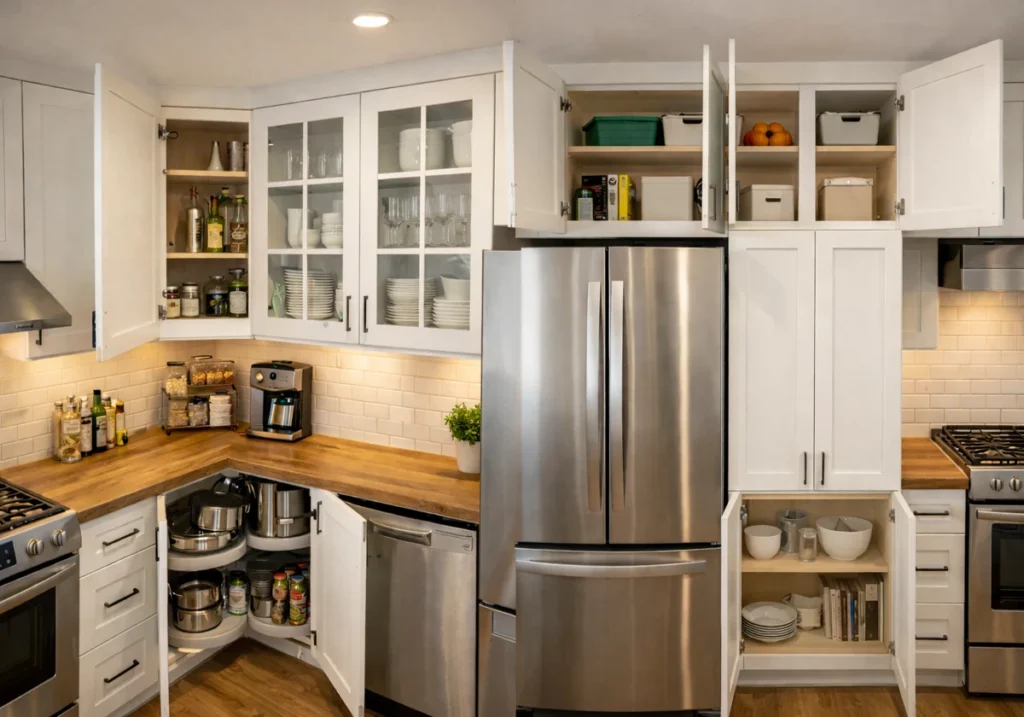
Cabinet door swing direction affects accessibility, where left or right hinges change how you grab items while cooking. Plus, Lazy Susans and pull-out organizers in corner cabinets prevent items from getting lost in dead space where you can’t reach.
Remember, glass-front cabinets work for display but require organized interiors since everything stays visible.
Then, tall cabinets near the ceiling provide additional storage for seasonal items, while you build cabinetry at counter height for daily use items.
Movement Patterns in Your Custom Kitchen Design
The kitchen work triangle connects the sink, stove, and fridge, keeping the total distance between 12 – 26 feet for comfortable cooking sessions. This work triangle concept puts your three points of cooking within easy reach.
Traffic lanes through the kitchen should avoid crossing directly through primary work zones during meal preparation. However, different kitchen layouts handle this differently. For example, an L-shaped kitchen keeps the work triangle tight in one corner, while a U-shaped kitchen spreads it across three walls.
Beyond these, a single-wall kitchen lines everything up, which works for a small footprint but creates more walking in a larger kitchen.
Most importantly, one-cook versus two-cook kitchens need different clearance widths, and shared spaces require wider pathways between workstations. The kitchen triangle also needs to accommodate waste disposal near the sink.
Determine Cabinet Dimensions Based on Reach and Use
Base cabinet depth affects counter overhang, while deeper cabinets provide more storage but reduce legroom at seating areas. The overall large or small footprint of the space then influences how those cabinet dimensions are planned.
Usually, a wall cabinet depth (12-15 inches) should prevent hitting your head while working at countertops below it. And toe-kick height (3-4 inches) lets you stand close to counters without foot discomfort during long cooking sessions.
Design Your Kitchen Around How You Really Cook
Your kitchen layout should work for how you cook today and how that might change next year. The distance between your sink, stove, and fridge affects every meal you make. When the layout fits your cooking habits, meal preparation feels easier and faster.
Small changes in cabinet dimensions or appliance placement can save hours each week. You don’t need a complete renovation to improve kitchen workflow, just thoughtful adjustments to how your space functions.
Ready to plan a kitchen layout that actually fits your cooking style? Sweet Lydia’s Kitchen helps homeowners in San Diego create functional, comfortable kitchens.
Contact us today and let’s talk about what your space could become.